
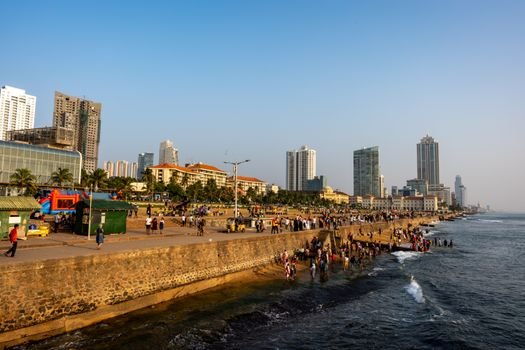
The recent announcement of a $40 million funding initiative for the Colombo port, backed by the World Bank’s International Finance Corporation (IFC) and HSBC, raises critical discussions about the strategic implications of such investments in Sri Lanka’s economic landscape. This infusion of capital could potentially position the port as a crucial hub within South Asia, especially amidst intensifying competition among regional ports and economic recovery efforts post-pandemic.

On one hand, the financing represents a tactical move to bolster infrastructure that has long been recognized as vital for enhancing trade capabilities. The Colombo port has been a pivotal point for shipping and logistics in the region, and additional funding could enhance its capacity and efficiency. Increased competitiveness would not only benefit local economic activities but also potentially attract more foreign investment in the country, providing essential support to Sri Lanka’s fragile economy.
However, the involvement of international financial entities like the IFC and HSBC cannot be viewed through a purely optimistic lens. Such funding often comes with strings attached—conditions that can dictate economic policies and infrastructure projects. This brings forward the question of sovereignty and the extent to which a nation can dictate its developmental trajectory when significant foreign investments are at play. The blend of external influence and local policy-making may lead to tensions, particularly if the stakeholders’ interests diverge from the needs of Sri Lankan citizens.
Moreover, the $40 million investment might appear substantial at first glance, but in the context of global supply chain complexities and the sheer scale of port operations, it prompts scrutiny regarding whether this is truly adequate. Internationally, many ports are undergoing extensive modernization efforts worth billions, designed to accommodate larger vessels and streamline operations. Will this funding sufficiently position Colombo to compete effectively, or merely allow it to keep pace with other major South Asian ports?
Additionally, Sri Lanka’s economic volatility presents significant risks for such investments. While foreign capital can provide immediate financial relief, reliance on international funders poses inherent risks during economic downturns, particularly given the country’s challenging fiscal landscape. Stakeholders must consider the long-term sustainability of this funding arrangement if Sri Lanka’s economic situation does not stabilize.
In conclusion, while the $40 million funding for the Colombo port stands as a promising development in improving infrastructure and trade capabilities, the broader implications merit careful consideration. Stakeholders must navigate the intricacies of foreign investments, ensuring that they serve the national interest without compromising economic autonomy. As the project unfolds, continuous oversight and transparency will be crucial in aligning the project goals with the long-term vision of sustainable economic growth for Sri Lanka.