
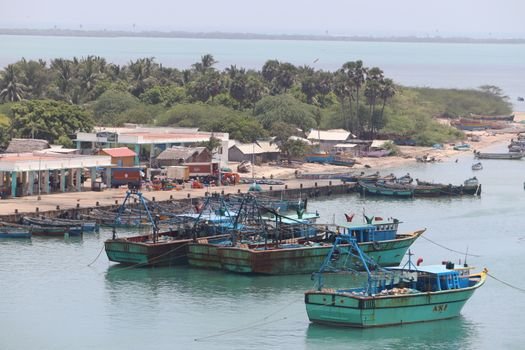
The recent arrest of nine fishermen from Rameswaram by the Sri Lankan navy serves as a stark reminder of the complex and often fraught relationship between India and Sri Lanka concerning maritime rights and fishing practices. This incident, while specific in its nature, highlights broader issues of sovereignty, economic uncertainty, and regional tensions.

Rameswaram, a prominent coastal town in the Indian state of Tamil Nadu, has long been a hub for fishing communities. The fishermen, now in the midst of legal uncertainty, represent not only their individual livelihoods but also the ongoing struggle faced by countless other fishermen in the region. The repeated enforcement of maritime boundaries raises critical questions about national interests versus community welfare.
The fishermen’s arrest underscores the precariousness of the fishing industry, which operates under the constant threat of political and legal repercussions. It’s worth noting that the arrest of nine individuals can have a ripple effect, impacting families and the local economy. With fishing often perceived as a primary source of income for coastal communities, the implications are profound.
Furthermore, tensions frequently flare between Indian fishermen and Sri Lankan authorities, who claim that Indian vessels encroach on their territorial waters. Historical grievances, fueled by both economic disenfranchisement and nationalist narratives, complicate this issue. This incident starkly illustrates how deeply intertwined local economies are with the geopolitical landscape of the region.
While the Sri Lankan navy’s actions may be framed as an enforcement of legal boundaries, it is essential to challenge the narrative surrounding such moves. Are these arrests an assertion of sovereignty or a misguided approach that fails to recognize the socio-economic context? If the fishing practices of local communities are increasingly criminalized, it begs the question of who truly benefits from these policies.
As the fishermen from Rameswaram face potential legal battles, the broader question remains: how can both nations navigate their maritime disputes without sacrificing the livelihoods of vulnerable communities? The answer demands a nuanced dialogue that prioritizes collaboration over confrontation.
In an era where shared resources may becomes contentious, the plight of these detained fishermen calls for urgent attention and action from both governments. Diplomatic efforts must focus not merely on enforcement but on understanding, cooperation, and resolution—one that acknowledges the socio-economic realities for those whose lives depend on the sea. The well-being of both nations hinges on their ability to engage thoughtfully in these disputes, lest they become mired in cycles of arrest and resentment.