
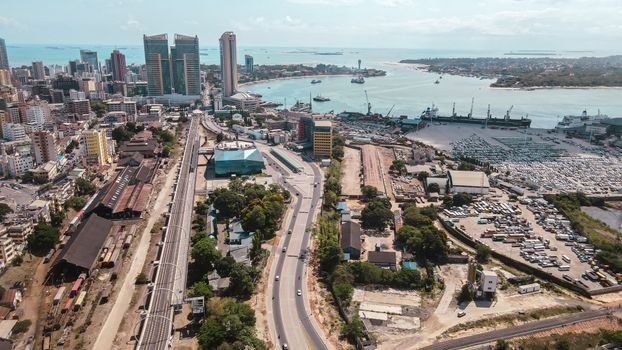
The announcement that the firm SOM has won the competition to master plan Port City Colombo marks a significant moment for urban development in Sri Lanka. This project, envisioned to transform part of the Colombo coastline into a thriving urban hub, is not merely a design challenge; it is a pivotal juncture in the confluence of architecture, engineering, and socio-economic reinvention.

SOM, renowned for its ambitious and controversial projects, is tasked with a $15 billion development in an area that has the potential to reshape Sri Lanka’s economic future. Positioned along the Indian Ocean, Port City Colombo is not just a land development project; it encompasses 269 hectares expected to include residential units, commercial spaces, and public parks. The promise of 83,000 new jobs alongside $13.5 billion in economic returns suggests a significant uplift for a nation grappling with economic challenges.
However, a project of this scale provokes critical questions. Who truly benefits from the influx of investment and development? The promise of economic growth often masks deeper socio-economic disparities. Will the local community have access to the jobs created? Will the infrastructure be designed to accommodate the existing population, or will it cater primarily to expatriates and wealthy investors? As with many large-scale developments, it is imperative to scrutinize whether the economic benefits will actually trickle down to the everyday citizens of Colombo.
Moreover, urban planning in the face of climate change is an ever-pressing concern for coastal developments. The Port City project is situated precariously on the edge of vulnerability, facing the looming threat of rising sea levels and extreme weather events exacerbated by climate change. A robust planning strategy not only focuses on immediate aesthetic and functional appeal but also on long-term sustainability and resilience. Questions arise: Is SOM prepared to address the ecological implications of their designs? Will they incorporate protective measures against environmental degradation?
The strategic importance of the Port City project extends beyond Sri Lanka’s borders, as it is part of a larger vision facilitated by China’s Belt and Road Initiative, aiming to enhance trade links and economic corridors throughout Asia. The geopolitical ramifications of such an investment play a crucial role in understanding the dynamics at stake. How will Sri Lanka negotiate its sovereignty and economic autonomy when intertwined with a foreign power’s ambitions?
In light of these considerations, it becomes clear that the success of the Port City Colombo master plan will be measured not only in financial terms but also through its ability to integrate and uplift the local populace, preserve ecological integrity, and assert national independence. As the project unfolds, continuous public dialogue and accountability will be essential to ensure that this grand vision serves the broader interests of a diverse community rather than the secluded ambitions of a privileged few.