
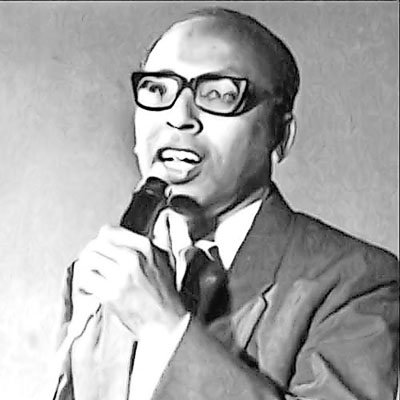
In the amber warmth of a Colombo reception hall or against the breezy seaside backdrop of Galle, an unmistakable phenomenon unfolds whenever a particular cadence strikes the air. A buoyant rhythm begins to shuffle, an acoustic guitar sparkles, and across the room, the generational divide collapses into sheer delight. Grandmothers abandon their seats to sway in time, while teenagers and university students belt out every verse in unison. More than half a century after his golden era, the music of C.T. Fernando does not merely summon nostalgic affection; it commands the room with the force of an unyielding artistic truth.


There are vocalists who manage to charm an era, and there are those who capture a single style. But Fernando occupied a rare, expansive territory in Sri Lankan music, commanding both the brisk, intoxicating pulse of upbeat celebration and the tender, lingering ache of sentimental ballads. At the core of this cross-generational reach lay an instrument of pure clarity—a voice that rang with the crystalline, resonant authority of a silver bell.
The Moratuwa Cradle and the Polished Suit
To understand the immaculate diction and melodic precision of Fernando is to trace the musical geography of Moratuwa. Born into a staunch Catholic family, he grew up in a coastal cradle where sacred liturgy and popular song lived in intimate dialogue—a cultural default that would also shape fellow luminaries like Clarence Wijewardene. Fernando found his earliest vocal training in the parish church choir and subsequently brought his disciplined ear to the capital, serving as choir master for the A.R.P. Messenger Service in Colombo.
When he emerged into the national consciousness during the spacious, unhurried days of the 1960s, he presented an image of refined dignity. Standing before the microphone in a sharply tailored coat and tie, Fernando sang without pretense or theatrical gimmickry. His delivery was clean, upright, and utterly self-assured. The lyricists who composed for him understood precisely what they held in trust; they sculpted sweet, poetic cadences knowing that only the singular warmth and projection of his voice could carry them to their zenith. Years later, when his own son stepped forward to interpret his father’s songbook, the effort served only to underline the elder Fernando’s peerless standard—a benchmark so formidable that any direct comparison could only ever produce a distant second.
From Cradle Lullabies to School Bus Anthems
Fernando possessed the rare gift of providing the soundtrack to an entire lifespan. Before most children in Sri Lanka even set foot in a classroom, his melody would already be woven into their consciousness. Through “Ambili Mame,” his gentle address to the ‘moon uncle,’ generations of mothers found a soothing lullaby to sing restless infants to sleep, establishing an emotional kinship with his voice from infancy.
As childhood opened outward into nature, “Piyumehi Pani Bothi” introduced young imaginations to the poetic metaphor of a forest bee drawing nectar from a blossoming lotus. Its effortless, bouncing cadence made it an indelible sing-along staple. For youth embarking on outdoor excursions, “Mee Amba Wanaye” became the undisputed anthem of camaraderie, ringing out from the windows of school buses and across flickering evening campfires, passed down with unadulterated joy from parents to children.
The Pulse of the Dance Floor
Yet Fernando was never confined to tranquil contemplation. His rhythmic vitality remains a pillar of Sri Lankan social life. In “Kimada Sumihiriye,” he crafted a romantic yet infectious masterpiece that remains an essential fixture of wedding dance floors and lively baila sessions, frequently reinvented by contemporary youth in acoustic mashups.
Similarly, the melodic sprint of “Sigiri Sukumaliye” has retained an astonishing modern momentum, standing as one of his most streamed tracks in the digital era. Modern outfits such as the band 2forty2 have embraced the song, demonstrating how effortlessly its syncopated charm bridges the mid-century recording studio and the twenty-first-century festival stage.
When the tempo finally slows, Fernando’s artistry turns inward to the bittersweet corridors of memory. In “Ma Bala Kale,” an evocative reflection on the innocence of early days, he captured a universal human longing that continues to anchor family reunions. Sixty years after he first stepped to the microphone, C.T. Fernando remains far more than an icon to swoon over; he stands as a vital, permanent architecture of Sri Lankan life, singing across time with a voice that refuses to fade.