
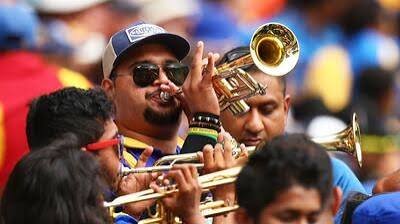
Under the blinding haze of the afternoon sun, amid the roar of the cricket stands and the spilling of drinks, a horn wails with ferocious, physical intensity. To witness a papare trumpeter mid-blast is to behold a marvel of human anatomy: cheeks stretching to improbable limits, jowls ballooning, deflating, and straining against the relentless resistance of brass. There is the happy-faced jowl, the knocked-out jowl, and the barely inflatable yet doggedly persistent jowl. Yet, amidst the manic ecstasy of the crowd, the musician’s face remains an enigma. He rarely looks up. He does not smile, nor does he yield to the delirium swirling around him. Papare is not for the faint-hearted, and its master practitioners treat the spectacle with the solemn gravitas of men who know life—and death—all too well.

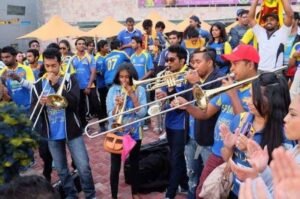
While sports enthusiasts and digital platforms covet the papare name to claim a piece of its irresistible allure, the true devotees know the unspoken truth of the craft. Long before these brass outfits became the booming heartbeat of sporting arenas and celebratory street rallies, their trade was forged in mourning. These musicians are funeral artists first and foremost. It is in the slow, solemn marches of bereavement that their embouchures were hardened. Transplanted into the fever pitch of a stadium, they remain a mesmerizing sideshow to the match itself: stone-faced purveyors of revelry whose impassive gazes anchor an otherwise chaotic carnival.
From Colonial Parishes to the 1958 Spark
The journey of this infectious sound traces back through layered strata of history, geography, and faith. Its sonic roots lie in the British colonial era, when military brass introduced instruments like the trumpet, trombone, and snare to island life. It was within the coastal cradles of Negombo, however, that local church and parish bands reclaimed these imperial horns. There, amidst village carnivals, patron saint feasts, and lively weddings, musicians began playing rolling, unbroken melodies designed to sweep crowds along in shared celebration.
From the streets of Negombo, the culture swept southward and eastward across the island. The definitive turning point arrived in the late 1950s with the wildfire popularity of “Dingiri Dingale Meenakshi,” a Tamil song from the 1958 film Anbu Engey. Quickly refashioned into local Sinhala tunes and married to galloping, syncopated percussion, the modern papare identity was crystallized—an unapologetic fusion that defied linguistic and regional barriers.
Rhythms of Baila, Devotion, and the Trance
Today, papare operates across a dynamic spectrum of hybrid rhythms. At its foundation lies Baila Papare, fueled by fast-paced, Portuguese-influenced cadences heard in numbers like “Kekiri Pelena” or “Kandy Lamissi.” Punctuated by piercing, heavyweight brass accents, these players refuse to stoop or slouch. Having cut their teeth standing vigil at solemn funeral processions, they deliver their baila standing rigidly erect, projecting sound straight into the stratosphere.
Then comes Kavadi Papare, also known as Molam. Drawing upon the searing devotional energy of South Indian and Tamil Kavadi temple and dewale processions, this style transcends ordinary entertainment. Driven by relentless, accelerating beats, the players often enter an almost hypnotic trance, channeling an ancient spiritual fervor into the secular heat of the stands. Blended seamlessly with Western rock and roll, the Twist, and modern Tamil and Hindi pop arrangements, the brass band transforms into an all-consuming sonic engine.
In an age where cultural expressions are often sanitized or repackaged for easy consumption, papare remains raw, exhausting, and unapologetically sweat-soaked. Behind the deafening horns and the kinetic dance circles stand the unsmiling men with the indestructible jowls, blowing life into the stadium, one breath away from the funeral march.