
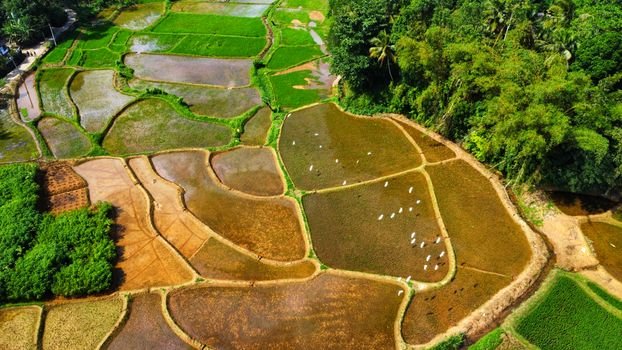
Farmers Push Back Against Early Maha Cultivation Plan
The National Agrarian Unity (NAU) has firmly rejected the Sri Lankan government’s proposal for an early start to the Maha cultivation season, asserting that the plan is ill-conceived and precariously dependent on uncertain weather predictions tied to the El Niño phenomenon. The Agriculture Ministry had hoped to safeguard the country’s rice supply by recommending that farmers plant approximately a month earlier than usual to circumvent potential disruptions from adverse climate conditions.

Concerns Over Water Capacity
Anuradha Tennakoon, President of the NAU, voiced strong concerns about the water storage capacity of reservoirs and irrigation systems, which he emphasized is critical for successful cultivation. He argues that government forecasts fail to account for the reality on the ground, stating, “The first factor we consider before starting cultivation is that reservoirs have at least 50% of their water capacity. Unfortunately, that’s not the case right now.” The farmers feel their livelihoods are at risk and that they cannot rely on government compensation if the early planting strategy does not yield expected results.
The Call for Renovation
Tennakoon criticized the government’s strategy as disconnected from farmers’ real conditions. He highlighted that there has been a persistent neglect of irrigation infrastructure, particularly accusing the Irrigation Department of their failure to renovate essential water tanks for over seven decades. “In the Kala Wewa system, 30%-40% of water capacity is consumed by silt accumulation. Most of the existing tanks have not been renovated, and the so-called repairs made by officials only mask the underlying issues,” he added.
Notably, the last significant renovation in the Kala Wewa region took place in 1970, which merely involved dam maintenance. “Real renovation is essential to increase capacity and support cultivation even amid reduced rainfall,” Tennakoon stated, urging the government to prioritize infrastructure improvements over premature planting initiatives.
Government’s Response and Future Implications
The government’s push for early cultivation comes as they anticipate unstable weather conditions that may disrupt the traditional Maha farming schedule. However, the NAU’s outright rejection of this plan may pose significant challenges to the agriculture sector, raising questions about food security and farmer resilience in the face of climate change.
Attempts to gain insights from Deputy Agricultural Minister Namal Karunarathne and Director General of Irrigation engineer Dr. K. Weligepolage about the government’s rationale and next steps were unsuccessful, leaving many farmers feeling unheard and vulnerable.
As the situation unfolds, it remains vital for the government to engage in dialogue with agricultural stakeholders and address the urgent need for renovation of water management systems to not only safeguard the farmers’ futures but also ensure national food security during increasingly uncertain climatic periods.